The Energy Shadow Over the Global Plate: Geopolitical Conflict and Alimentary Vulnerability
The Conflict in the Middle East and the Spectre of Scarcity
Abstract
This article analyses the interdependence between current geopolitical instability in the Middle East and global food security. Beyond immediate humanitarian pressures and migratory dynamics, it explores how volatility in hydrocarbon markets may affect the agro-industrial chain.
By examining the energy requirements of the Haber–Bosch process, the logistics of mechanised agriculture, and the maintenance of essential infrastructure such as asphalt and cement, the article highlights the structural exposure of modern food systems to energy disruptions.
It suggests that short-term mitigation may depend on a combination of demand rationalisation, targeted public intervention in essential markets, and a reduction in food waste, in order to limit the risk of wider nutritional and public health impacts.
Keywords: Food Security, Geopolitics, Hydrocarbons, Haber-Bosch Process, Global Logistics, Nutritional Vulnerability.
In recent weeks, the geopolitical landscape has been marked by escalating tensions across parts of the Middle East.
While the absence of a formal declaration of war may complicate terminology, the situation on the ground increasingly reflects conditions associated with armed conflict, with immediate humanitarian implications. Early signs of displacement are already emerging, placing additional pressure on host communities and on international and humanitarian organisations, many of which are operating under constrained financial conditions.
Beyond the immediate humanitarian dimension, these developments raise broader questions for global stability, particularly in relation to food security. Disruptions in hydrocarbon supply do not only affect energy markets; they may also reverberate across the systems that underpin food production and distribution.
Carbon Dependency in the Agro-Industrial Chain
To fully grasp the scale of the potential disruption, it is necessary to examine how deeply petroleum and natural gas underpin the functioning of modern food systems. Far from being peripheral inputs, these energy sources can be understood as a structural backbone of agricultural production, processing and distribution.
At the level of primary production, the dependency is immediate and visible. Nearly all agricultural machinery, from tractors to harvesting equipment, relies on petroleum derivatives, particularly diesel. Any constraint in fuel availability would therefore have direct operational consequences, limiting the capacity for large-scale planting and harvesting and reducing overall agricultural output.
This dependency becomes even more pronounced when considering fertiliser production. Contemporary agriculture relies extensively on nitrogen-based fertilisers to maintain soil productivity, and these are synthesised through the Haber–Bosch process. This industrial process requires significant quantities of natural gas, both as a feedstock and as an energy source. As a result, any disruption in gas supply, especially in the period preceding the Northern Hemisphere’s planting season, may represent a material risk to future yields.
Water management introduces an additional layer of exposure. In many regions, particularly those characterised by arid climates, irrigation systems depend on desalination infrastructure to ensure sufficient water supply. A substantial share of these facilities is located in parts of the Middle East, in areas that are, to varying degrees, exposed to current geopolitical tensions.
Finally, the broader logistics and preservation systems that sustain global food distribution are themselves highly energy-intensive. Transport, whether by land or sea, depends on a continuous flow of liquid fuels, while storage processes, including refrigeration and the controlled ripening of climacteric fruits, require stable access to electricity. In many major economies, including China and India, this electricity is still largely generated from fossil fuels, reinforcing the structural link between energy markets and food security.
Taken together, these dependencies help illustrate how disruptions in energy supply can propagate through the agro-industrial chain, ultimately translating into pressures on food availability, access and public health.
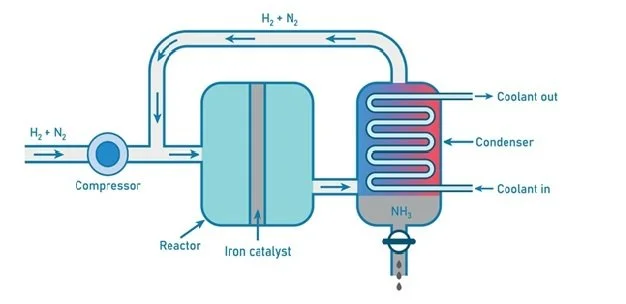
The Haber–Bosch process illustrates the structural dependence of modern agriculture on natural gas, as ammonia synthesis remains essential for fertiliser production and global food supply.
Sanitary Consequences: A Public Health Crisis
The sharp increase in food prices or, in some cases, outright shortages is not only a statistical concern; it can translate into tangible health impacts, even within developed countries.
Insufficient access to essential nutrients may place fetal development at risk and contribute to long-term growth impairments in children. At the same time, vulnerable groups such as the elderly, as well as individuals living with specific conditions, including coeliac disease, diabetes or autoimmune disorders, may encounter significant barriers in accessing the specialised diets on which their health depends.
Asphalt and Plastic: The Invisible Infrastructure
It is often overlooked that food logistics depend on the world’s approximately 64 million kilometres of roads. Asphalt, a petroleum-derived material, has a limited lifespan and requires continuous maintenance. Similarly, cement and steel, whose combined artificial mass already exceeds the Earth’s total biomass, according to the Weizmann Institute of Science, are highly energy-intensive to produce and maintain.
Plastics used for packaging and protection, derived from ethylene and propylene, currently lack readily scalable short-term substitutes offering comparable efficiency, further reinforcing the system’s reliance on hydrocarbons.
From Resilience to Intervention
In this context, the prospect of fuel and food rationing in the coming months cannot be entirely ruled out, particularly alongside the potential restriction of high-energy activities with limited essential value, such as mass tourism.
In the short term, mitigation is likely to depend on a combination of demand rationalisation and targeted public intervention aimed at safeguarding access to essential goods for more vulnerable groups. At the same time, public awareness may play a critical role: reducing food waste, currently estimated at around 30% of global production according to FAO data, represents one of the most immediate and practical measures available.
Ultimately, food security may be better understood not as a guaranteed condition, but as a fragile equilibrium, increasingly shaped by the stability of an energy system under sustained pressure.